Burnham’s Britain, ‘King of the North’ coronated as next Prime Minister
Seven prime ministers in ten years, and the newest one spent most of that decade 200 miles from Westminster. Andy Burnham walked into Downing Street this afternoon after an audience with the King, having been Labour leader only since Friday and an MP for just a month.
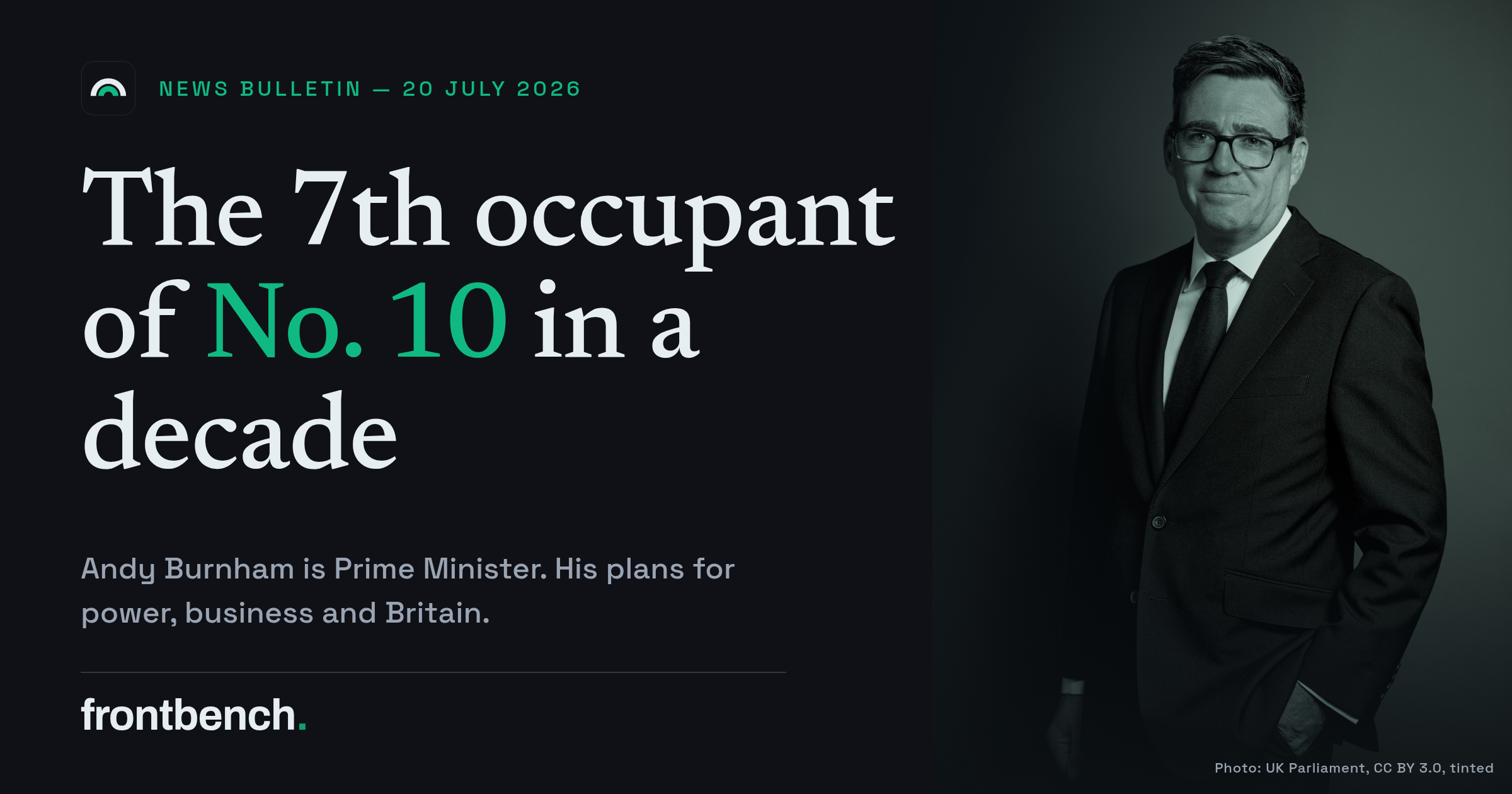
Seven prime ministers in ten years, and the newest one spent most of that decade 200 miles from Westminster. Andy Burnham walked into Downing Street this afternoon after an audience with the King, having been Labour leader only since Friday and an MP for just a month. He is the first premier in modern memory to arrive via the mayor's office rather than the front bench. But what can we expect from the new Prime Minister? His first speech gives some answers.
A redistribution of power from Westminster
Burnham's first address from the steps was, in effect, a statement of intent. Burnham's intent is to transform Westminster into an institution with a "new political […] and a new economic model", by "taking power out of here and carrying it into every postcode."
As ever, the commitments Burnham announced provided a top-level view of what policies his government will pursue, and at first glance, they look distinctly left wing. The issues that made the cut included: cost of living, ending rough sleeping, more council houses, mental health support, and putting "life's essentials back under public control."
One of the biggest questions underlying his promotion is whether Burnham can meaningfully convince business he's on their side. On that front, he has pre-empted the question, "I will be a pro-business leader of the Labour party as I was a pro-business mayor of Greater Manchester," he told his party on taking the leadership last Friday.
A new Cabinet by teatime
The reshuffle is under way, and several high-profile ministers have already moved. Rachel Reeves is gone from the Treasury, and replaced to widespread surprise by John Healey, a Blair-era Treasury hand, with Louise Haigh, Burnham's closest ally, installed as his Chief Secretary. David Lammy, Steve Reed, Peter Kyle and Liz Kendall are all out, and ITV has reported that Ed Miliband is heading to the Foreign Office.
The values guiding Burnham's Britain
Behind the staging, Burnham's programme has a coherent core, built over nine years running Greater Manchester: Britain's problem is a hyper-centralised state, and the fix is to push money, power and production outwards. Expect a "No. 10 North" in Manchester, aggressive devolution deals, re-industrialisation through public procurement, and "sovereign capabilities" in shipbuilding, energy, AI and quantum.
Two things temper Burnham's radicalism. First, the money: Burnham has committed to existing borrowing limits and fiscal discipline, and Healey's appointment should be read as reassurance for the establishment. Second, much of the industrial strategy is a rebranding and acceleration of what Reeves was already doing, not a redirection.
Burnham's attitude towards foreign policy, however, will be one to watch. Burnham calls the US relationship "critical" rather than "special", is in no rush to visit Washington, and has criticised the last government for being "too slow to call for a Gaza ceasefire", floating sanctions on illegal Israeli settlements. The most pro-European PM since Blair will, paradoxically, say little about Europe: the postponed UK–EU summit will be rescheduled, but the red lines on the single market and free movement stay in place (at least for now).
The great legitimacy question
One of the challenges facing Burnham is legitimacy. According to polls, only 27% of Britons think he should be PM without a general election, and the two obvious precedents for a mid-term coronation, Gordon Brown and Theresa May, are not stories with happy endings. No election is required until August 2029. Whether Burnham can wait that long, and whether Reform will let the question rest, is the real drama of the next twelve months.
Sources: NPR, CFR, gov.uk, ITV News, Bloomberg, 19–20 July 2026. Analysis is Frontbench's own. Within the next 48 hours, users of Frontbench can expect updated forecasts on how their policy priorities will land with Burnham's cabinet, in the Intelligence Hub.
Get intelligence like this, matched to your priorities.
Frontbench tracks every bill, committee, consultation and motion overnight and surfaces what matters to your organisation.