The party conference guide for charities
A practical guide for charity policy teams. Get the most value once you're there, and track whether the promises made turn into policy afterwards.
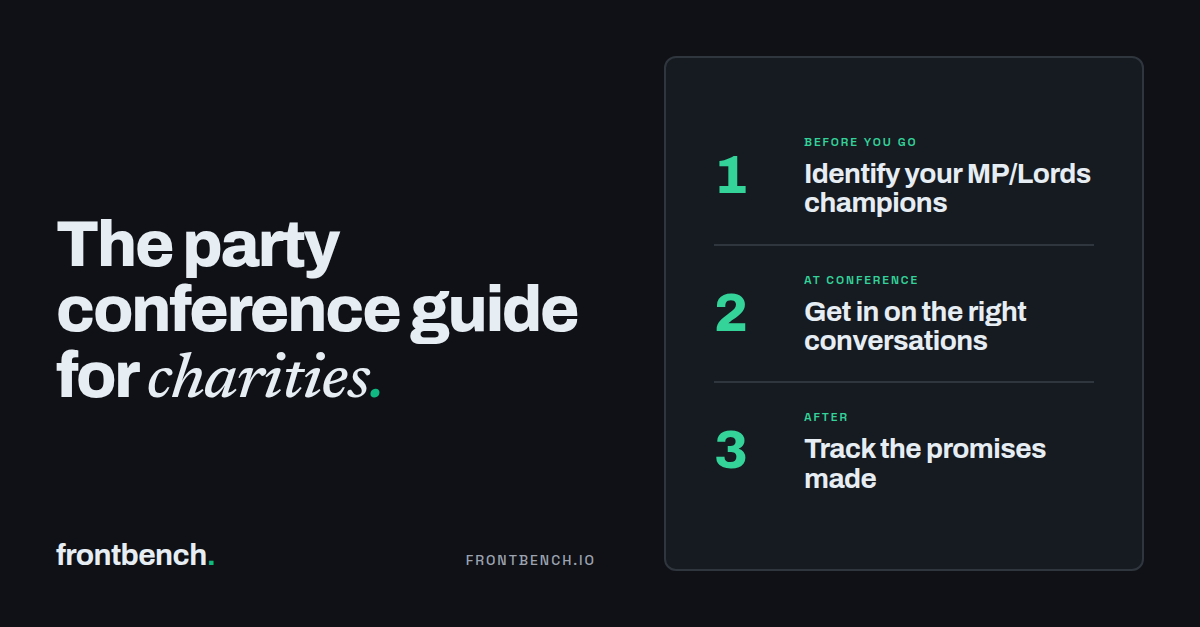
This is a practical party conference guide for charities: how to work out who is worth your time before you go, and what to do once the delegates go home.
The Liberal Democrats are in Brighton this week, running their Autumn Conference from 19 to 22 September. Labour's Annual Conference follows on 27 to 30 September in Liverpool, and the Conservatives close the season at the ICC in Birmingham from 4 to 7 October.
In between, Westminster empties: the Commons rose for conference recess on 15 September and does not sit again until 12 October. For three and a half weeks, the people who normally take your emails are not in their Westminster offices. They are standing in an exhibition hall or a fringe room in a conference city instead, which is exactly why party conferences are worth the train fare.
Before you go: work out who actually moves on your issue
Before you book a single fringe ticket, build a short list of who genuinely moves on your issue in the Commons:
- The select committee members for the department that owns your issue. Committee remits are broader than their names suggest: the Education Select Committee, for example, covers children's social care as well as schools, so a SEND charity and a children's social care charity should both be watching the same committee. Membership pages are public on the UK Parliament website and worth checking regularly, because reshuffles and committee changes are a common occurrence.
- The APPG chairs and officers who works on your issue between the big debates. The APPG register lists every officer by name, and a chair who has spoken at three of your sector's events is usually a warmer door than a minister who has never mentioned the issue in the chamber.
- The minister and shadow minister who currently hold the brief. Check the current ministerial list against your notes from six months ago before you assume anything.
None of that requires a subscription to anything. It requires twenty minutes and the discipline to do it before conference rather than in the taxi on the way there.
Before you go: pick your fringe sessions
Fringe programmes at all three conferences run into the hundreds of sessions across a handful of days, and no policy team of one or two people can cover more than a fraction of them. Work backwards from the target list you just built, not from whichever panel title sounds most interesting.
Check the party's own conference app or fringe finder as soon as it goes live and cross-reference it against your list. If someone on your list is speaking on a panel, that is a free, scheduled way to hear how they are thinking about your issue right now, without needing to book a meeting or hope for a corridor moment. It is also lower pressure for both of you than an ambush in a coffee queue.
Check what kind of pass you actually need before you book. Fringe and exhibition passes are usually far cheaper than a full conference pass, and for most charity policy teams that is all that is needed, but pass tiers and prices change year to year, so confirm the current structure on the party's own conference site rather than assuming last year's rules still hold.
How to make the most of party conference once you're through the door
The real value of conference is proximity, not the main stage. You can watch the leader's speech and the chancellor's speech on your phone from your desk, and plenty of policy teams do exactly that while spending their actual conference time in the room where the people who make decisions.
A few things that make the corridor work in your favour rather than wasting it:
- Go to the evening receptions as well as the daytime panels. The formal sessions are where people perform their position. The receptions are where they say what they think, because nobody is being quoted.
- Walk the exhibition floor deliberately. The stalls run by think tanks, other charities and APPG secretariats working your issue are an easy way to find out what everyone else in your space is currently worried about, which tells you what your target MPs are hearing from every direction, yours included.
- Have your one-line ask ready before the conversation happens, not during it. Corridor conversations last ninety seconds. Nobody will remember your organisation's full policy position, but they might remember one clear, specific thing you asked for.
- Book accommodation early. Conference host cities book out weeks in advance, and a two-hour commute into Liverpool each morning erases most of the advantage of being there at all.
After conference: track whether the promises turn into policy
Speeches and fringe panels produce a lot of warm words. A minister announces a review. A shadow minister commits to backing an amendment. Someone tells you personally, in a corridor, that they will "look into it." All of that evaporates the moment conference ends unless somebody writes it down and checks whether it happened.
Build a short tracker while you're still at conference: who said what, where, and what it would look like if it were kept. Then watch for it afterwards in the places these things actually surface: a bill introduced or amended, a written ministerial statement, a select committee inquiry opened, a government consultation launched.
This is also where Frontbench earns its place in a policy team's workflow. It watches Hansard, bill stages, motions and consultations overnight and tells you the moment a conference-season commitment resurfaces, or quietly doesn't.
The short version
Work out who actually sits on the committee or chairs the APPG for your issue before you go, not once you're there. Pick fringe sessions that put you in the room with that list, and check what pass you genuinely need. Once you're at conference, spend your time in the corridors and the evening receptions rather than only the main hall, and go in with one clear ask. Then write down every commitment you hear, and check in the weeks afterwards whether it turned into anything a select committee, a bill or a consultation would recognise. Conference season rewards teams who treat it as three weeks of groundwork rather than three days out of the office.
Get intelligence like this, matched to your priorities.
Frontbench tracks every bill, committee, consultation and motion overnight and surfaces what matters to your organisation.