How to track a bill through UK Parliament
The stages a bill goes through, where most bills fail, and how to read a bill's odds, powered by Frontbench's data on Parliament.
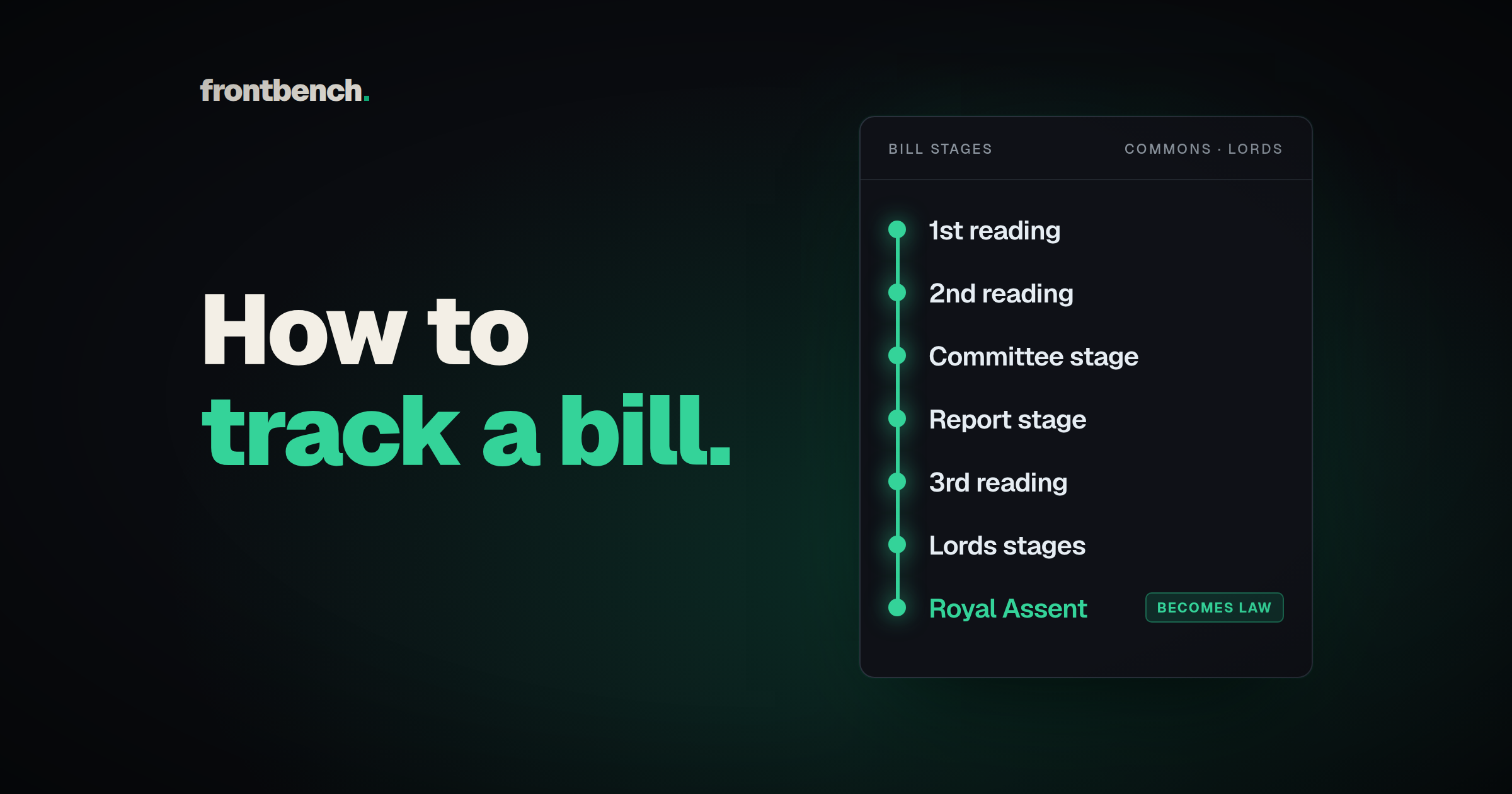
To track a bill through Parliament, you need to know which stage it has reached, whether that stage is a real hurdle or a formality, and how likely it is to clear the next one. If you watch one stage, make it the second reading. Of the 300 bills that have fallen in the current Parliament, 90.7% stopped there, nearly always because they ran out of parliamentary time, not because MPs voted them down. A bill that clears second reading has passed the hardest test it will face.
The figures in this guide come from Frontbench's analysis of UK Parliament data. They cover the current Parliament, which began on 4 July 2024, and count only bills that have reached a final outcome: they became law, fell, or were withdrawn. Many more bills from this Parliament are still in progress, so the numbers will change as those resolve.
How do you track a bill through Parliament?
You follow it through a fixed sequence of stages in both Houses, and at each point you need to know what has happened, what comes next and how similar bills have fared. For public affairs work, this tells you when to brief your board, when to lobby, and when a bill that looked threatening or promising is effectively dead.
What are the stages of a bill, in order?
A public bill goes through the same five stages in each House, then a stage to settle any disagreement between the two Houses, then Royal Assent. Private Members' Bills follow the same path. What differs is how much time each type of bill is given, covered below.
- First reading. A formal introduction: the bill's short title is read out and the text is published. There is no debate and every bill clears it, so it tells you nothing about a bill's prospects.
- Second reading. The first real test. The House debates the bill's general principles and can vote on whether it goes any further. Most bills that fail, fail here.
- Committee stage. Line-by-line scrutiny. A public bill committee, or the whole House for major and constitutional bills, considers amendments clause by clause.
- Report stage. The whole House can amend the bill again, usually some weeks after committee. The Speaker chooses which amendments are debated and voted on.
- Third reading. The final Commons vote on the bill as amended. No further amendments can be made in the Commons at this point.
- The same five stages in the second House. A bill that starts in the Commons then goes through first reading, second reading, committee, report and third reading in the Lords. Lords committee stage is usually taken on the floor of the House, and Lords debates are largely self-regulating rather than time-limited.
- Consideration of amendments ("ping pong"). If the Lords amends the bill, it goes back to the Commons. It can pass between the Houses until both agree the same text, or the bill is dropped.
- Royal Assent. Once both Houses have agreed the same text, Royal Assent is granted and the bill becomes an Act of Parliament.
There are two exceptions. The Speaker can certify a bill that deals only with taxation or public spending as a money bill, and the Lords can then delay it only briefly. Under the Parliament Acts, the Commons can in some cases pass a bill without Lords agreement if the Lords has rejected it and the Commons passes it again in the following session. Most bills, government and backbench, go through the full sequence.
Which stage should you watch?
Second reading. Of the 300 bills that have fallen in the current Parliament, this is where most of them stopped:
| Final stage reached | Fallen bills | Share of all falls |
|---|---|---|
| 2nd reading | 272 | 90.7% |
| 1st reading | 13 | 4.3% |
| Committee stage | 11 | 3.7% |
| Report stage | 2 | 0.7% |
| 3rd reading | 1 | 0.3% |
| Consideration of Commons amendments | 1 | 0.3% |
| Total fallen | 300 | 100% |
Almost all of those second-reading falls were in the Commons, where Presentation Bills and Ten Minute Rule Bills wait for sitting-Friday time that rarely comes. Past second reading, few bills fall: only 15 of the 300 (5%) reached committee stage or later before failing.
None of the 381 bills that reached an outcome in this Parliament were voted down on the floor. The ones that failed ran out of time. So a bill that has sat at second reading for months is not necessarily unpopular. It may be waiting for time that bills of its type seldom get.
How can you tell if a bill is likely to become law?
Look at its type and sponsor first. They predict the outcome far better than anything in the text. Government bills almost always pass. Every backbench route succeeds much less often, and two of them have not produced a single Act this Parliament:
| Bill type | Bills | Became law | Fell | Withdrawn | Success rate |
|---|---|---|---|---|---|
| Government Bill | 58 | 57 | 1 | 0 | 57 of 58 |
| PMB (Ballot) | 21 | 6 | 14 | 1 | 28.6% |
| Private Bill | 2 | 2 | 0 | 0 | 100% |
| PMB (Presentation) | 152 | 2 | 144 | 6 | 1.3% |
| PMB (Ten Minute Rule) | 115 | 0 | 109 | 6 | 0% |
| PMB (Lords) | 33 | 0 | 32 | 1 | 0% |
| All bills (terminal only) | 381 | 67 | 300 | 14 | 17.6% |
A government bill, sponsored by a minister, is very likely to pass, so it deserves close attention from the start. A Ballot Bill, from one of the twenty backbench MPs drawn at the start of the session and given guaranteed Friday time, passes 28.6% of the time, so about two in three still fall. Presentation Bills and Ten Minute Rule Bills get no guaranteed time and are mostly used to raise an issue rather than to change the law. Across all four backbench routes, 321 bills have reached an outcome this Parliament and 8 became law, a rate of 2.5%.
Private Bills are a separate case. They give powers to a named body, such as a local authority, and are promoted from outside Parliament rather than by an MP. With only 2 in the data, they tell you little.
How do you follow a bill day to day?
bills.parliament.uk shows every bill's current stage, its text at each version and its stage history, and Parliament's email alerts tell you when a bill you follow moves. For what was said at each stage, and by whom, Hansard has full transcripts of debates in both Houses.
Those sources give you the record, but not what a stage means for a bill's chances, and checking dozens of bill pages is time consuming and potentially costly. Frontbench tracks every bill against your organisation's priorities and gives each one a passage forecast based on the data above: bill type, sponsor, stage reached, and how similar bills have resolved this Parliament. The forecast updates as the bill moves. See how it works, or read the full data behind these numbers in what percentage of UK bills become law.
FAQ
How do you track a bill through Parliament? Follow its stage on bills.parliament.uk, sign up to Parliament's email alerts to hear when it moves, and read the Hansard transcripts for each stage. Frontbench does this automatically for the bills you track and adds a passage forecast based on how similar bills have resolved.
What are the stages of a bill? First reading, second reading, committee stage, report stage and third reading in the first House, the same five stages in the second House, consideration of amendments ("ping pong") if the Houses disagree, then Royal Assent. Private Members' Bills follow the same sequence. Money bills and bills passed under the Parliament Acts are the main exceptions.
Which stage do most bills fail at? Second reading. Of the 300 bills that have fallen in the current Parliament, 272 (90.7%) stopped there, almost all in the Commons, where backbench bills wait for sitting-Friday time that rarely comes.
How do you know if a bill will become law? Start with its type and sponsor. This Parliament, government bills have passed in 57 of 58 cases and Ballot Bills in 28.6%. Presentation Bills have passed in 1.3% of cases, and Ten Minute Rule Bills and Lords Private Members' Bills in none. A bill that has cleared second reading is a much safer bet than one still waiting for it.
Methodology
The data covers the current Parliament from 4 July 2024 to 19 September 2026 (381 bills), checked against Parliament's Sessions on 19 September 2026. It is the same dataset used in what percentage of UK bills become law.
Bills from this Parliament that are still in progress are left out of every figure above until they resolve. All figures are as of 19 September 2026. If a number looks wrong, please tell us.
Get intelligence like this, matched to your priorities.
Frontbench tracks every bill, committee, consultation and motion overnight and surfaces what matters to your organisation.