What percentage of UK bills become law? Data from the 2024 parliamentary term
About 17.6% of bills in the current UK parliamentary term have become law so far, counting those that have reached a final outcome. Here are the numbers by bill type, from Frontbench's own tracking.
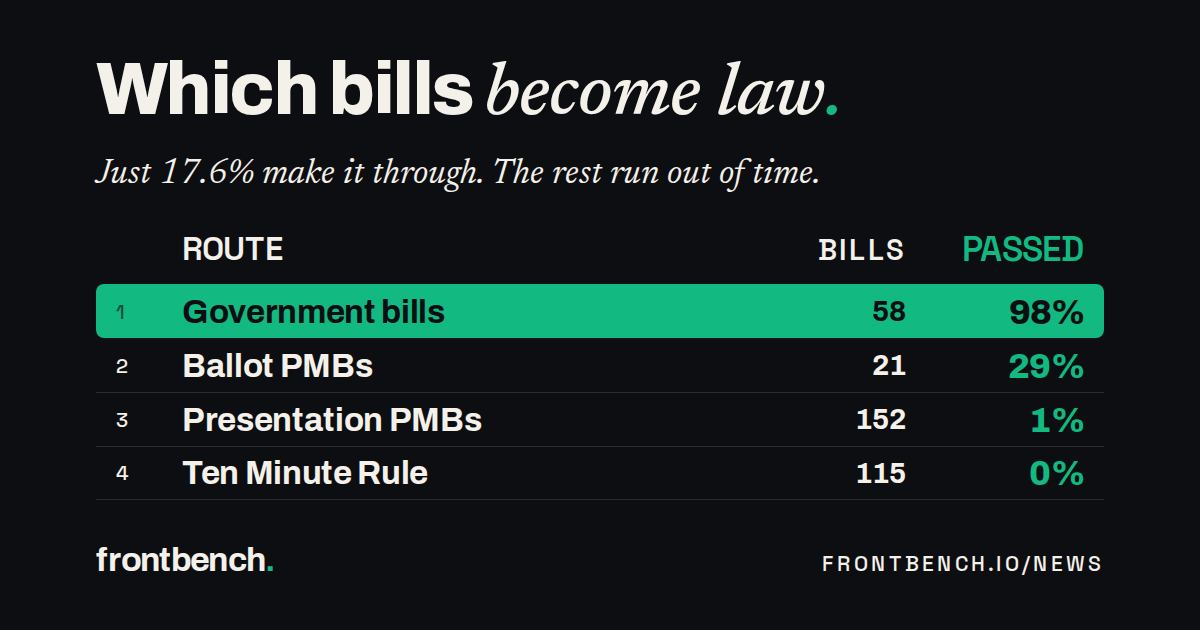
About 17.6% of bills introduced in the current UK parliamentary term have become law so far. That's 67 of 381 bills that have reached a final outcome (became law, fell, or were withdrawn) since this Parliament began on 4 July 2024, according to Frontbench's own bill-outcome tracking.
This Parliament is still sitting. A further 263 bills are still live and aren't counted in that figure yet, so the rate will move as they resolve. Government bills have succeeded in nearly every attempt.
What percentage of bills become law in the UK right now?
About 17.6%, so far this Parliament. Of the 381 bills introduced since 4 July 2024 that have reached an outcome, 67 became law, 300 fell, and 14 were withdrawn.
A further 263 bills from this Parliament are still progressing through the Commons or Lords and haven't reached an outcome yet.
Does the type of bill change the odds?
Yes. Government bills have succeeded in nearly every case. Opportunities for backbench MPs to introduce law are much more likely to fail.
Every bill type in the current Parliament, outcomes only (as of 17 September 2026):
| Bill type | Bills | Became law | Fell | Withdrawn | Success rate |
|---|---|---|---|---|---|
| Government Bill | 58 | 57 | 1 | 0 | 57 of 58 |
| PMB (Ballot) | 21 | 6 | 14 | 1 | 28.6% |
| Private Bill | 2 | 2 | 0 | 0 | 100% |
| PMB (Presentation) | 152 | 2 | 144 | 6 | 1.3% |
| PMB (Ten Minute Rule) | 115 | 0 | 109 | 6 | 0% |
| PMB (Lords) | 33 | 0 | 32 | 1 | 0% |
| All bills | 381 | 67 | 300 | 14 | 17.6% |
All Private Bills proposed in this parliamentary session have passed, but there have been only two of them. Private Bills are a specialist, low-volume category, used to grant powers to a named body such as a local authority or an organisation.
Oftentimes confused, a Private Members' Bill is tabled by a backbench MP or peer, and a Private Bill is promoted from outside Parliament by the body that wants the powers, and petitions for it through a registered parliamentary agent.
Why do most Private Members' Bills fail?
Mostly because they run out of parliamentary time, not because MPs vote them down. Private Members' Bills get a handful of Friday sitting days a year, and government business always takes priority. Consequently, most bills never reach the front of the queue before the session ends.
Combined across all four Private Members' Bill routes, 321 bills have reached an outcome this Parliament, with 8 becoming law (2.5%), 299 falling, and 14 being withdrawn.
Of the 300 bills that have fallen this Parliament, 90.7% died waiting for a second reading that never came:
| Final stage reached | Fallen bills | Share of all falls |
|---|---|---|
| 2nd reading | 272 | 90.7% |
| 1st reading | 13 | 4.3% |
| Committee stage | 11 | 3.7% |
| Report stage | 2 | 0.7% |
| 3rd reading | 1 | 0.3% |
| Consideration of Commons amendments | 1 | 0.3% |
| Total fallen | 300 | 100% |
A bill that clears second reading has already got through the hardest part of the queue. Falls become rare after that. Only 15 of 300 fallen bills (5%) died at committee stage or later.
None of the 381 bills in this Parliament's dataset were formally voted down on the floor of the House of Commons. Commons majorities kill bills by letting the clock run out, not by defeating them in a vote.
What is a Ten Minute Rule Bill's success rate?
Zero, so far this Parliament. Of the 115 Ten Minute Rule bills that have reached an outcome, none became law.
That's not a small-sample quirk. 115 is a large group, close to double the number of government bills in the same period. A Ten Minute Rule Bill exists to let an MP make a short speech on an issue and force a brief debate, usually to test opinion, generate press coverage, or put a marker down ahead of a manifesto commitment. It's a platform for raising an issue, not a serious attempt to legislate, and most MPs who use it know that this is the case.
Do Ballot Bills have better odds?
Yes, considerably better than the other Private Members' Bill routes. Of the 21 Ballot Bills that have reached an outcome this Parliament, 6 became law, a rate of 28.6%, while roughly two in three fell.
The mechanism explains the gap. Twenty MPs are drawn by ballot at the start of each session and given priority Friday time, the scarce resource that sinks almost everything else on this list. A Ballot Bill still faces long odds against a government bill, but it sits in a different class from a Ten Minute Rule Bill or a Presentation Bill, which get no guaranteed time at all.
If you're trying to get a bill passed
These numbers are the honest starting point for deciding where to put lobbying effort. A government bill is worth backing if it aligns with your priorities, because it's already likely to pass. A Ten Minute Rule Bill is worth using for visibility, not for the expectation that it becomes law. A Ballot Bill sponsor is worth investing real time in, because the odds are meaningfully better than every other backbench route.
Instead of guessing whether a Presentation Bill or a Ballot Bill is worth your organisation's time, you get a working estimate for each one you follow, updated as it moves. See how it works for the detail, or sign up free to track your first bill and see its forecast.
FAQ
What percentage of bills become law in the UK right now? About 17.6%. Of 381 bills from the current Parliament (since 4 July 2024) that have reached a terminal outcome, 67 became law (Frontbench bill-outcome tracking, as of 17 September 2026). A further 263 bills from this Parliament are still live and not yet counted, so this figure will move as they resolve.
Why do most Private Members' Bills fail? Mostly because they run out of parliamentary time, not because MPs vote them down. Government business always takes priority for the limited Friday sitting days available to backbench bills. Of the 300 bills that have fallen this Parliament, 90.7% died waiting for a second reading that never came, and none of the 381 terminal bills was formally voted down on the floor of the House of Commons.
What is a Ten Minute Rule Bill's success rate? Zero, so far this Parliament. Of 115 Ten Minute Rule bills that have reached a terminal outcome, none became law. A Ten Minute Rule Bill exists to let an MP make a point and force a short debate, not as a realistic route to legislation.
Do Ballot Bills have better odds? Yes. Of 21 Ballot Bills that have reached an outcome this Parliament, 6 became law, a rate of 28.6%, while roughly two in three fell. That's still far behind a government bill, but well ahead of every other backbench route.
Methodology
Scope: current Parliament only, from 4 July 2024 to 17 September 2026 (n = 381 bills). This dataset was checked bill-by-bill against Parliament's own API and confirmed at 99.7% coverage for this period.
Get intelligence like this, matched to your priorities.
Frontbench tracks every bill, committee, consultation and motion overnight and surfaces what matters to your organisation.